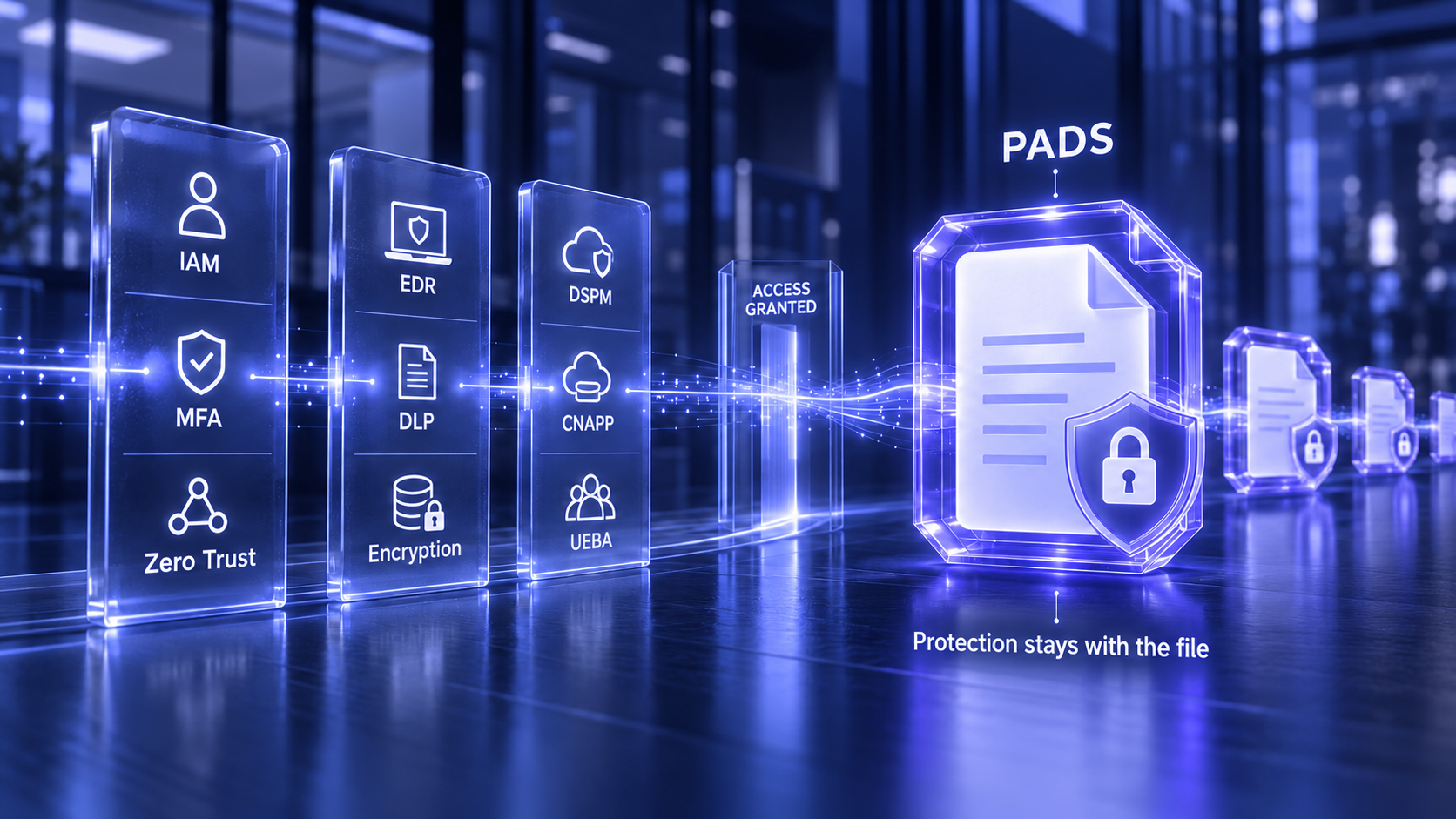
Data Protection
Why Post-Access Data Security (PADS) Is the Missing Layer in Modern Cybersecurity
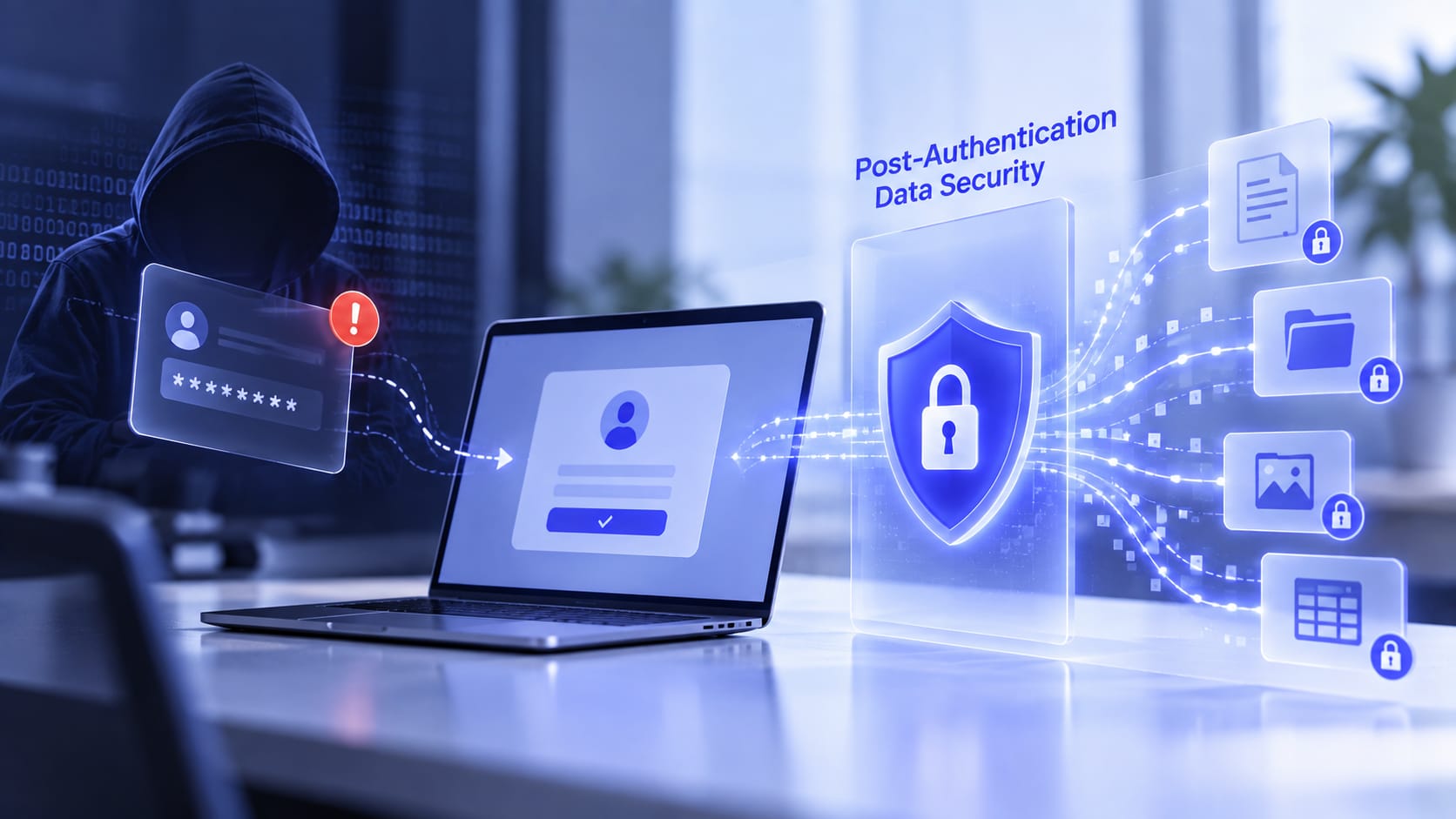
Modern breaches don’t break defenses-they log in. When credentials are abused, encryption disengages and data decrypts. PADS protects data after login, where traditional tools fail.
Nike. Snowflake. Uber. Conduent. Waymo. MOVEit.
Different industries. Different tools. Different years. The same outcome.
In each of these breaches, attackers ultimately stole sensitive files or datasets by operating inside trusted, authenticated access, exploiting a security model that assumes access controls equals data safety.
For more than a decade, organizations have invested heavily in cybersecurity platforms and frameworks meant to keep data safe. And yet sensitive files continue to walk out the door without triggering alarms until the damage is already done.
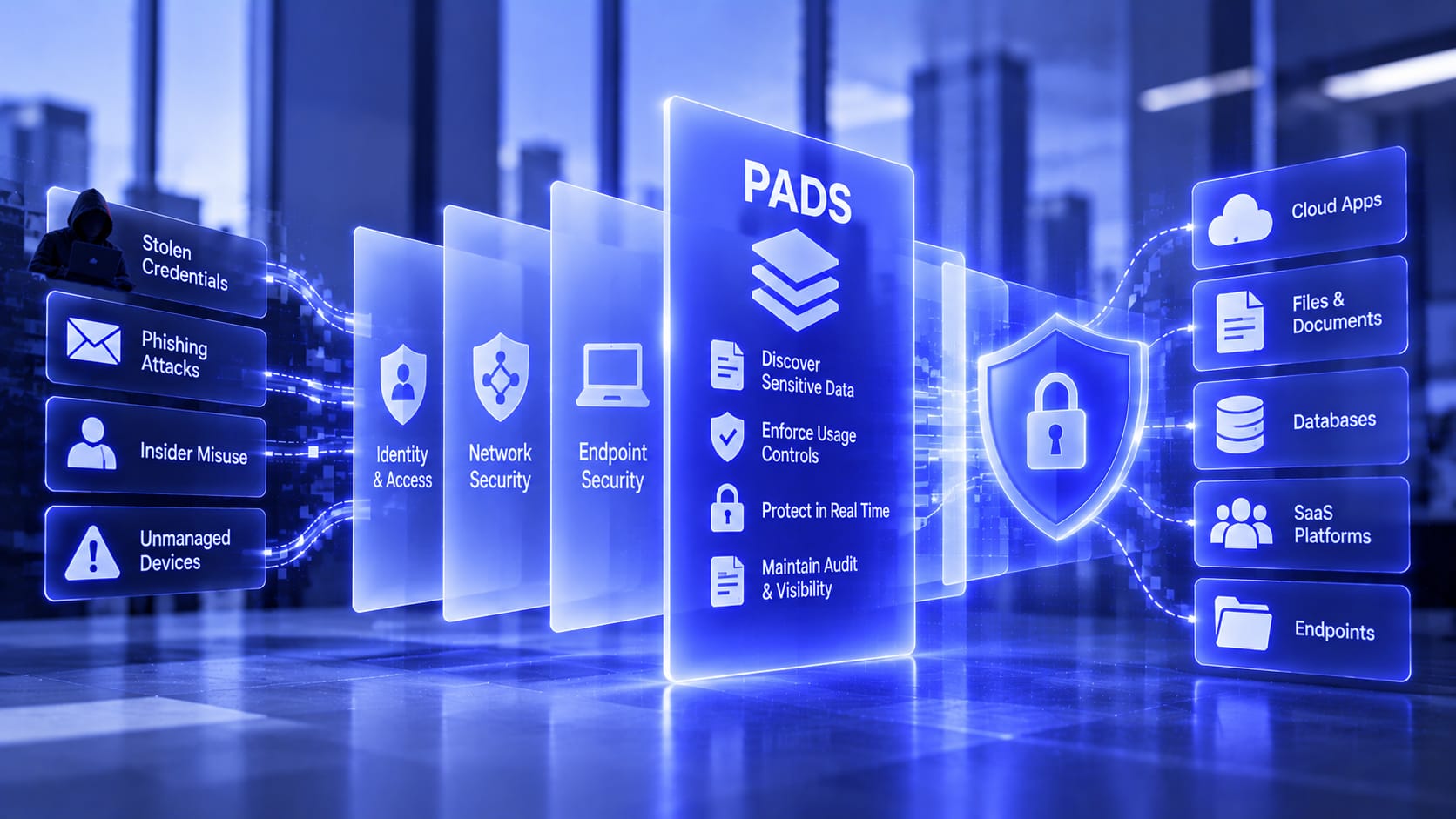
The reason is uncomfortable but consistent. Modern security architectures protect environments. They do not protect data after login.
Attackers no longer need to break in. They authenticate. Once they do, encryption disengages, controls defer, and files decrypt automatically. Systems cooperate. Theft becomes routine.
Every major breach listed above exposes the same structural flaw, and we will demonstrate how in this article. The industry has spent years reinforcing the perimeter while leaving the data unprotected at the moment it matters most.
Post-Access Data Security exists to close that gap. It was built for the post-login reality where trust has already been abused and perimeter defenses are irrelevant. It is the missing layer that determines whether a breach ends with disruption or with irreversible data loss.
Until leadership demands protection at the file level, organizations will keep funding security programs that perform perfectly right up to the point where the data is taken.
1. Why Traditional DLP Fails in Real Breaches
DLP was designed to detect and block suspicious data movement. It was never designed to stop an authenticated user from opening a file.
That limitation has been exposed repeatedly.
Nike Corporate Data Breach (2025)
The Nike breach did not revolve around customer credit cards or consumer accounts. The attackers targeted the company’s internal files.
A cyber-extortion group claimed to have exfiltrated roughly 1.4 terabytes of internal data, including nearly 190,000 documents related to product design, manufacturing processes, and supply-chain operations.
These were not database records. They were corporate files - documents, internal resources, and intellectual property.
Once attackers gained access to the environment, the systems behaved exactly as designed.
Files opened. Files exported. Files left the environment.
Why traditional controls failed
- DLP did not trigger because the activity occurred inside authenticated sessions
- Encryption at rest protected storage, not usage
- Files decrypted automatically once accessed
How PADS would have changed the outcome
Sensitive files would remain encrypted unless opened under approved identities, devices, and contexts. Exfiltrated documents would remain unreadable outside those conditions.
Snowflake Customer Breaches (2024)
The Snowflake incidents exposed a dangerous assumption many organizations make about cloud platforms: legitimate access equals safe access.
Attackers obtained valid credentials to multiple Snowflake customer environments. Once authenticated, they used legitimate tools to export massive datasets containing customer information and operational records.
The activity looked normal because it was normal.
Why traditional controls failed
- DLP has limited visibility inside SaaS environments once authentication succeeds
- Encryption at rest protects stored data but disengages when data is queried and exported
How PADS would have changed the outcome
Exported datasets would remain encrypted outside approved contexts.
2. Why Insider Access Remains the Hardest Threat
Not every breach begins with malware. Some begin with legitimate employees.
Waymo Trade Secret Theft (2016)
One of the most famous intellectual property theft cases in Silicon Valley history involved a senior engineer leaving Google’s self-driving car program, Waymo.
Before departing, he downloaded roughly 14,000 confidential engineering files, including detailed designs related to LiDAR technology used in autonomous vehicles.
There was no exploit. No malware. No perimeter failure.
The employee had legitimate access.
Why traditional controls failed
Authentication succeeded. Access permissions were valid. Encryption protected storage but not usage.
How PADS would have changed the outcome
Files copied outside the environment would remain encrypted and policy-bound.
3. Why Supply Chain Platforms Amplify Data Theft
Many organizations rely on third-party infrastructure to move sensitive files. When those systems fail, the impact multiplies.
MOVEit Supply Chain Breach (2023)
MOVEit Transfer is a managed file transfer platform used by thousands of organizations to exchange large volumes of sensitive files.
A zero-day vulnerability allowed attackers to access MOVEit servers and download stored files directly.
The result was one of the largest supply-chain breaches in recent history, affecting thousands of organizations and tens of millions of individuals.
The stolen data consisted primarily of:
- documents
- HR records
- financial files
- other unstructured datasets
Why traditional controls failed
Encryption at rest protected stored files but not file transfers.
How PADS would have changed the outcome
Downloaded files would remain encrypted and unusable outside approved contexts.
4. Why Zero Trust Does Not Prevent Data Theft
Zero Trust verifies identity before granting access. It does not control what happens after access is granted.
Uber Internal Systems Breach (2022)
Attackers targeted a contractor connected to Uber.
Once authenticated, they accessed:
- internal documentation
- engineering resources
- operational tools
Screenshots of internal systems circulated publicly shortly afterward.
Why traditional controls failed
Authentication and authorization succeeded. Systems trusted the session.
How PADS would have changed the outcome
Exported documents would remain encrypted and unusable outside approved environments.
5. Why Encryption Alone Is Not Enough
Encryption is widely deployed across modern infrastructure, but most implementations only protect data at rest.
Once users authenticate, encryption typically disengages.
Conduent Government Services Breach (2024)
Conduent, a major provider of government and enterprise services, experienced a breach affecting millions of individuals.
Attackers accessed internal systems and exfiltrated files containing personal and healthcare data used to support government programs.
Why encryption failed
Encryption protected storage, not usage. Files decrypted automatically when accessed.
How PADS would have changed the outcome
Files would remain encrypted and policy-bound even after access.
The Pattern Is Clear
Across Nike, Snowflake, Waymo, MOVEit, Uber, and Conduent, the same sequence appears:
- Attackers accessed trusted systems
- Traditional tools trusted them
- Files left the environment
PADS exists because the threat model finally changed.
The Solution: PADS
PADS changes the unit of protection from systems to data.
- Files remain encrypted everywhere
- Policies travel with the data
- Access is re-evaluated continuously
- Exfiltrated files stay unreadable
- Insider misuse becomes visible
- Credential compromise becomes survivable
This is the missing layer in modern cybersecurity.
The Standard Leadership Must Demand
There is one test that matters.
If an attacker logs in using valid credentials, can they read your files?
If the answer is yes, the organization has infrastructure security — not data security.
PADS raises the standard. It assumes compromise and denies value. It turns breaches into contained events instead of existential failures.
This is not an incremental improvement.
It is a structural correction.
And it is long overdue.