Data Protection
Why Your Current Stack Needs Post-Access Data Security
Keep every control. IAM, MFA, Zero Trust, EDR, DLP, and the rest each answer a question about access - here's what each one still needs once access is granted.

Keep every control. Here’s what each one still needs.
Your security stack is doing its job. The question is what job each control was built to do.
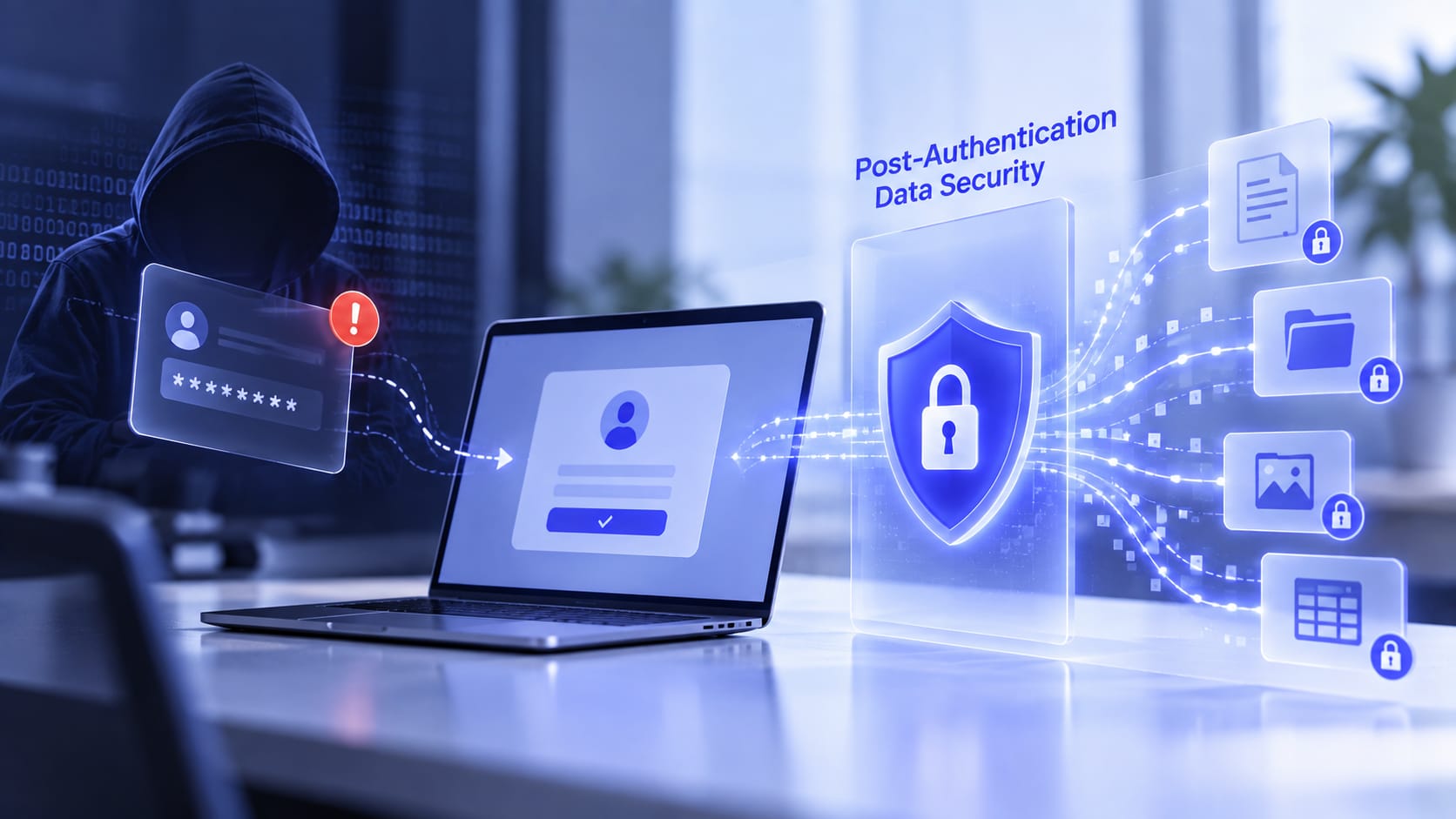
Every one of them answers a question about access: who gets in, whether to trust the session, whether the endpoint looks safe, whether data is moving where it shouldn’t. Once access is granted, those questions have been answered, and what happens to the file next is a different question that none of them was built to ask. That’s the post-authentication gap.
Closing it doesn’t mean replacing anything. It means adding the layer each control hands off to.
What each control does well, and what it needs next
| Control | What it does well | Where it hands off | What it needs next |
|---|---|---|---|
| IAM | Decides who gets in, across every system | Its job ends when access is granted | Something that governs what that identity can do with the file |
| MFA | Confirms identity at login | Says nothing about the session afterward | Something that stays in force for as long as the file is in use |
| Zero Trust | Evaluates whether access should be granted | Governs the session, not the file inside it | Something that governs the file whether or not the session is still trusted |
| EDR | Catches malicious behavior on the endpoint | Permitted activity doesn’t look malicious | Protection that doesn’t depend on behavior looking wrong |
| DLP | Catches data movement that matches a policy | Normal-looking use gives it nothing to match | Protection that stays with the file whether or not its movement looks unusual |
| Encryption (at rest) | Keeps stored data unreadable without the key | A valid session gets the key | Encryption that persists through use, not just storage |
| DSPM | Shows what sensitive data you have and where | Doesn’t enforce what happens once someone reaches it | Enforcement of the policy that discovery identifies |
| CNAPP | Secures how your cloud environment is configured | Works at the environment, not the file inside it | Protection that holds whatever the configuration |
| UEBA | Flags unusual user activity | Often flags it after the data has moved | Prevention at the moment of use |
Nine controls. Nine different needs. One missing layer.
Why better versions of the same tools won’t close it
Every tool above shares a goal: make a breach less likely. That’s worth doing, and it has a ceiling. However good your controls get, the probability of a breach never reaches zero. Even so, the average breach now costs $4.99 million globally and $11.5 million in the U.S. (IBM, 2026)
The layer your stack is missing is built around a different question. Not “can we stop this from happening?” but “if it happens anyway, does it matter?”
- Your current stack lowers the odds of a breach.
- PostAuth lowers what a breach costs you when the odds don’t hold.
The data-centric tools you may already own need it too
| Approach | What it does well | Where it hands off | What it needs next |
|---|---|---|---|
| DRM / IRM | Enforces usage rules (no copy, print, forward) in compatible applications | It typically depends on a cooperating application | Enforcement that applies whatever opens the file |
| Classification-gated protection | Targets protection at data that’s been labeled | Unlabeled and mislabeled files stay exposed, and many programs stall before enforcement | Protection that doesn’t wait for a label |
| Platform-specific key sharing | Protects externally shared files with proprietary keys | Recipients outside the ecosystem often need matching software | Protection that stays with the file without forcing recipients onto a platform |
The standards you answer to assume it
| Standard | What it asks of you | Where it hands off | What it needs next |
|---|---|---|---|
| Breach notification laws | Disclose when data is accessed or acquired without authorization | Triggers are generally tied to access or acquisition, and the specifics vary by jurisdiction | A way to show what the data was worth to whoever took it |
| Safe-harbor and encryption provisions | Reduce obligations when data was encrypted | They’re typically written around encryption at rest | Encryption that survives a valid login |
| Audit frameworks (CMMC, HIPAA, GLBA, ISO, NIST) | Show access controls are correctly configured | Audits generally verify that access was controlled, not what happened after | Something concrete to show about data protection after access |
| Standard of care in litigation | Match reasonable industry practice at the time of a breach | Benchmarks tend to reference access-layer controls | Protection that goes beyond what the benchmark currently asks |
What the missing layer has to do
If your stack needs something to pick up where each control hands off, here’s what to look for:
- It stays with the file. Protection that lives in the environment stops at the environment’s edge.
- It doesn’t wait for a label. Imperfect tags can’t be the trigger for protection.
- It doesn’t depend on the application. Protection can’t rely on whatever opens the file to cooperate.
- It doesn’t depend on the activity looking wrong. Valid access, normal behavior, and a healthy endpoint are exactly the cases to cover.
- It covers human and AI actors. An agent with legitimate access is another actor with access.
- It works alongside what you have. Adding a layer shouldn’t mean replacing your stack.
That’s the specification for post-access data security, and it’s what PostAuth is built to do. See How PostAuth Works →
Why it can’t wait
The gap isn’t a temporary blind spot that better versions of these same tools will close. It’s structural: every control was built to answer a question about access, and once access is granted, its job is finished by design. Waiting for IAM, DLP, or DRM to evolve into something that governs post-access use is a bet that tools built for one job will become something they were never designed to be.
The numbers point the same way. The human element is involved in 62% of breaches, and security teams fully remediated only 26% of critical vulnerabilities. (2026 Verizon DBIR) Access will keep getting granted to the wrong person, the wrong agent, or the right one at the wrong time.
Access and use are two different questions. Your stack answers the first. This layer answers the second.
See How PostAuth Works → · Replay the Breaches → · Talk to an Expert →